

How much of your hope depends on your being able to keep going? Picture someone who has spent three years driving a parent to treatments, or leading a small group that has slowly thinned, or sitting with a friend whose recovery keeps stalling. They began with energy. Now they wonder what happens if that energy gives out. We often answer with a call to try harder or a compliment about how strong they are. The writer of Hebrews does urge tired believers to keep going. When he explains why their hope can hold, though, he points them away from the firmness of their own grip and toward what God has promised and what Jesus has done.
The setting is sobering. Just before today’s passage, the writer says his hearers have become spiritually dull and still need basic teaching when they ought to be teaching others. He then gives one of the most severe warnings in the New Testament, about people who have been enlightened, have shared in the Holy Spirit, and then turn away from God. Christians who take Scripture seriously have disagreed about who is described and how the warning applies, and one short study will not settle that question. The warning should not be trimmed down to something harmless. Anyone deeply troubled by it deserves patient conversation with a trusted pastor or mature believer. We can also notice what the writer does next. He calls his hearers “Dear friends” and says, “We are confident that you are meant for better things, things that come with salvation” (Hebrews 6:9, NLT).
His encouragement rests first on God’s character, and it takes notice of what they have been doing. “For God is not unjust. He will not forget how hard you have worked for him and how you have shown your love to him by caring for other believers, as you still do” (Hebrews 6:10, NLT). Their care for one another was love shown to God, and it was still going on. The verse does not say that their work earned a place with him. It says that God does not overlook it. The writer then asks them to keep loving as long as life lasts, to make certain that what they hope for will come true, and to follow those who inherit God’s promises through faith and endurance. Love and patience are how hope is lived out over time. A person who is waiting on God still has meals to carry, calls to return, and someone to sit beside.
Discussion Topic:
Which helps you keep caring for someone when you are tired: a promise from Scripture, a faithful friend, or honest rest? One word is enough.
Abraham is the example. God said to him, “I will certainly bless you, and I will multiply your descendants beyond number” (Hebrews 6:14, NLT). The words come from Genesis 22, after Abraham had been willing to give up Isaac, the son through whom the promise was to continue. Abraham had already waited many years for that son to be born. Hebrews says that he waited patiently and received what God had promised. Later the same letter says that Abraham and others died still believing, having seen the fuller promise only from a distance (Hebrews 11:13). We should be careful with his story. God made a particular promise to Abraham. It gives none of us a guarantee that a certain job will open, a marriage will be restored, or an illness will lift because we waited well. What it shows is the character of the One who makes promises.
The writer presses that point with an illustration from ordinary life. People who take an oath call on someone greater than themselves to hold them to it. God had no one greater to name, so he swore by himself. His word was already completely reliable. He added the oath so that those receiving the promise could be perfectly sure that he would not change his mind. This is generous. God gave an added assurance to people who needed one. “So God has given both his promise and his oath. These two things are unchangeable because it is impossible for God to lie. Therefore, we who have fled to him for refuge can have great confidence as we hold to the hope that lies before us” (Hebrews 6:18, NLT). We do hold on. What we hold has been secured by someone else.
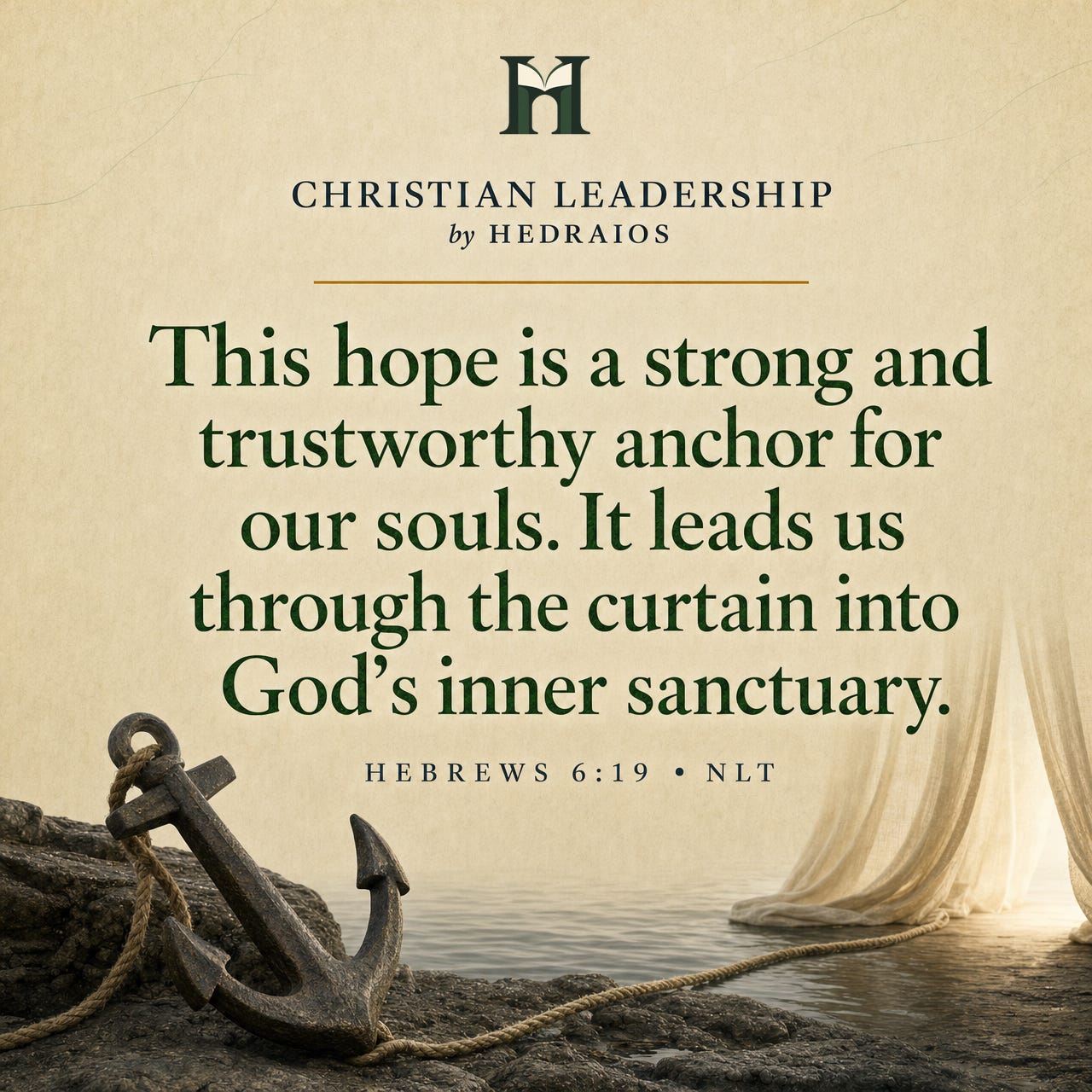
Then comes the picture many readers remember: “This hope is a strong and trustworthy anchor for our souls. It leads us through the curtain into God’s inner sanctuary. Jesus has already gone in there for us. He has become our eternal High Priest in the order of Melchizedek” (Hebrews 6:19-20, NLT; read Hebrews 6 on ScriptureMapping, WEB). A ship’s anchor drops out of sight and holds in a place no one on deck can inspect. This anchor reaches into God’s own presence. The curtain recalls the tabernacle, where the most holy place was screened off and only the high priest could enter, once a year, bringing blood for his own sins and for the people’s. Jesus has gone in for us. The World English Bible calls him a forerunner here, one who goes ahead where others are meant to follow.
The name Melchizedek may sound like a strange place to end. He appears briefly in Genesis as a king and priest who blessed Abraham, and Psalm 110 speaks of a priest forever in his order. Chapter 7 explains why this matters. Earlier priests died and had to be replaced. Jesus lives forever, so his priesthood does not pass to anyone else. His own appointment was confirmed with God’s oath, and he offered himself once for all. Of those who come to God through him, the writer says, “He lives forever to intercede with God on their behalf” (Hebrews 7:25, NLT). Our hope rests on a priest whom death will never remove and who needs no successor.
This does not make endurance automatic. The same writer who speaks of an unbreakable promise also tells his readers to keep loving, to resist drifting, and to hold on. Resolve matters, and it will have weak days. On those days a believer need not manufacture a feeling of certainty before praying. Someone can say, “I am tired and afraid,” and still turn toward the God who cannot lie and the Savior who has gone ahead. Seeking sleep, medical care, counsel, or relief from a duty is compatible with that hope. A caregiver who lets another person take Tuesday’s shift has not let go of the anchor. The love Hebrews commends is shared among believers, and no single person was meant to supply all of it.
We can give one another these reasons in plain words. “You’re so strong” leaves a weary friend with their strength to rely on. “I saw you stay with him all afternoon. God does not forget love like that. I can take the next visit.” Those words offer something firmer and something practical. Hope spoken this way does not demand a cheerful reply or promise a particular outcome. It reminds a person that God has seen their love, that his word holds, and that Jesus has already entered the place where their hope is fastened. Our resolve is real, and it is allowed to be small. The anchor does not take its strength from us.
Leadership Challenge
Read Hebrews 6:9-20 slowly, then think of one person who has been caring for others over a long stretch. It may be a family caregiver, a volunteer, a pastor, or a colleague who keeps showing up for someone in trouble. Tell that person one specific act of love you have noticed. Share one ground of hope from the passage in your own words, without implying that their situation will turn out a certain way. Then offer one concrete form of relief with a day attached, such as a meal on Thursday or two hours so they can rest, and accept their answer if they decline. If you are the one who is worn out, tell a trusted person what you need and let them carry part of it.
I write about leadership at the intersection of timeless principles and modern workplaces. Follow for weekly insights on building teams that actually work. For more articles like this consider subscribing to my Substack at: https://christianleadership.now