

A leader I know had a strong decade. His team was loyal, his board was confident, and his reputation for calm under pressure was genuine. Then, over about eighteen months, something shifted. Not in one dramatic moment anyone could point to. He started getting sharper in meetings, then curt, then dismissive. A private bitterness entered his public posture. Decisions that once moved through a deliberate process started getting made fast, alone, and late at night. His best people began leaving. By the time his organization formally removed him from leadership, most of the room already understood that it had to happen. What they could not explain was when, exactly, he had become that person.
He could not explain it either. He told me afterward: “I stopped guarding my inner life. I was running the organization while abandoning the fortress.”
This is the failure mode February has been building toward. Not the dramatic scandal. Not the obvious moral collapse. The slow-motion dissolution of a leader who stopped doing the maintenance. The city does not fall because the walls were poorly built. The city falls because the Watchman fell asleep at an ordinary hour, on an ordinary afternoon, and let something through the gate that should have been stopped.
The Watchman and the Gate
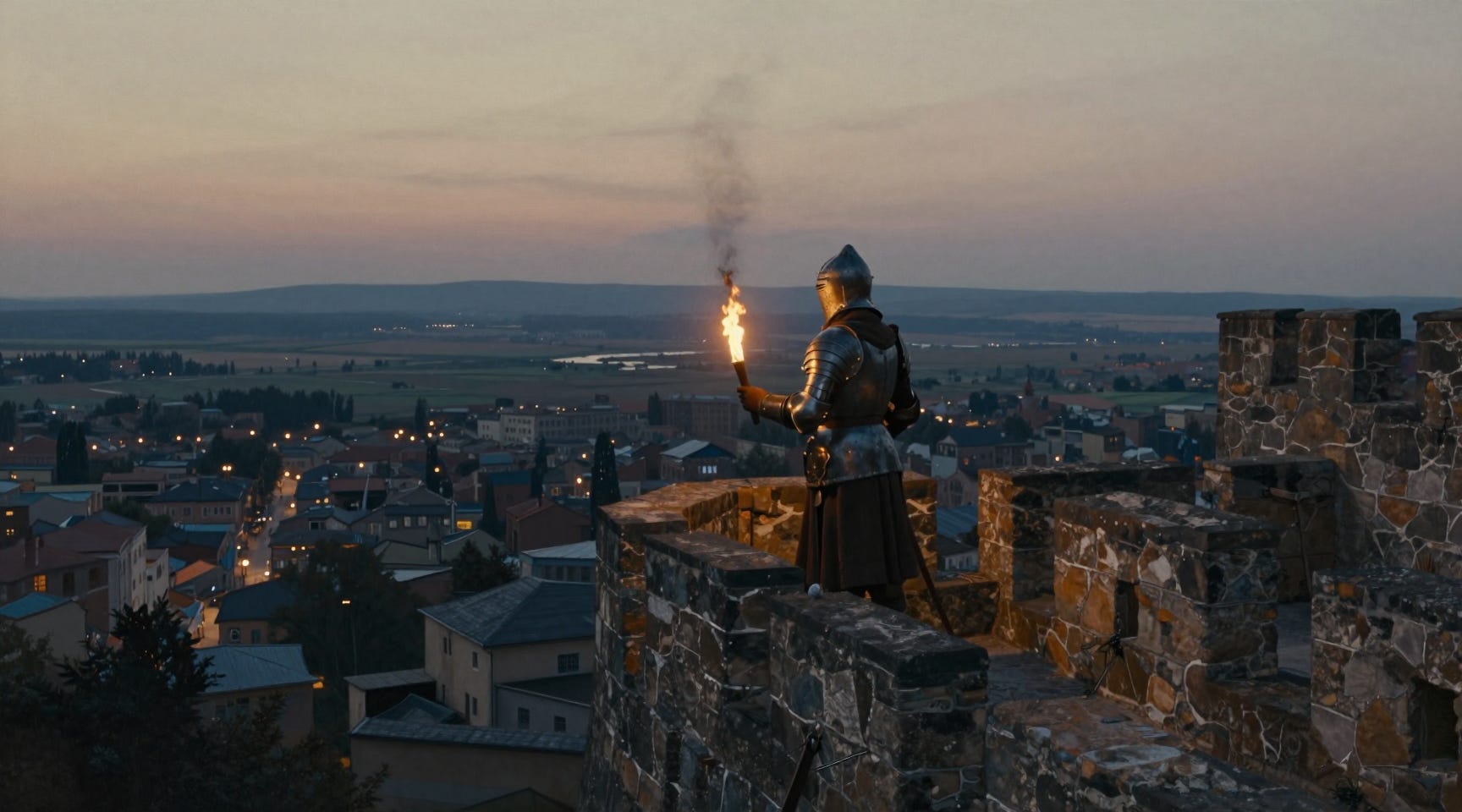
The Watchman’s Protocol is built on a single organizing metaphor. You are a watchman standing at the gate of a fortress. Behind you lies everything you have built: your integrity, your relationships, your team’s trust, your word. In front of you, at all hours, visitors arrive. Some are allies. Some are enemies wearing convincing disguises. Some are genuine emergencies. Many are false alarms dressed up as crises. Your job is not to predict which is which before they arrive. Your job is to have a protocol for interrogating every visitor before you operate the gate.
Most leaders do not have a protocol. They have moods, instincts, and a belief that experience will protect them. Experience helps, but it does not protect you from yourself. The threat at the gate is not primarily external. The threat is the impulse that presents itself as wisdom, the reaction that dresses itself as principle, the urgency that convinces you that waiting is weakness. The enemy most often does not come with a battering ram. He comes as a well-reasoned email you almost sent. A private resentment you let run long enough to become a public posture. A shortcut you took when no one was watching, and then again, and then again.
Why Willpower Is Not the Answer
Most leaders who understand the problem still reach for the wrong solution. They decide to try harder. They make a new commitment to self-control. They read a book about habits or discipline or emotional intelligence. These tools are not useless, but they address the symptom rather than the system. Willpower is a finite resource, and it depletes in direct proportion to pressure. The moments when you most need self-governance are precisely the moments when your reserves are lowest: late at night, under public scrutiny, when you have been running on fumes for three weeks, when someone presses the specific button you have never managed to rewire.
What governance requires is not a stronger will. It requires a practiced protocol. A protocol does not depend on how you feel when you use it. It is a pre-decided sequence of actions that runs regardless of your emotional state. It is the brake system, not the driver’s resolve. You cannot think a freight train into stopping when it is already rolling downhill. You need a mechanism that engages before the situation demands your best self, because under maximum pressure, your best self is rarely available.
The Complete Watchman’s Protocol
For twenty-eight days this month, we built The Watchman’s Protocol from the ground up. Daily articles covered one piece of the framework at a time: the kinetic energy of sin, the H.A.L.T. diagnostic, the Three Witnesses, kinetic faith at the flooding river. Today, this guide gathers every piece into a single comprehensive reference you can return to whenever the gate is contested.
The Protocol is four movements, each named for the Watchman’s action at the gate.
ARREST: Stop the momentum of the incoming impulse before it gains entry.
AUDIT: Interrogate the credential. Examine the source and the motive.
ALIGN: Check standing orders. Calibrate to Truth using the Three Witnesses.
ACT: Operate the gate. Let in the ally. Drive out the enemy. Move with obedience even when conditions are imperfect.
This is the framework. What follows is the complete guide to using it.
You have been reading the free preview of this month’s paid guide. The full article, including deep-dive breakdowns of all four protocol steps, three complete real-world case studies, a Standing Orders worksheet, a Common Failure Modes section, and four appendix reference tools, is available to paid subscribers. If you have followed this series all month and want to put the complete framework into practice, this is the guide you have been working toward.
Upgrade your subscription to access the full guide below.
