

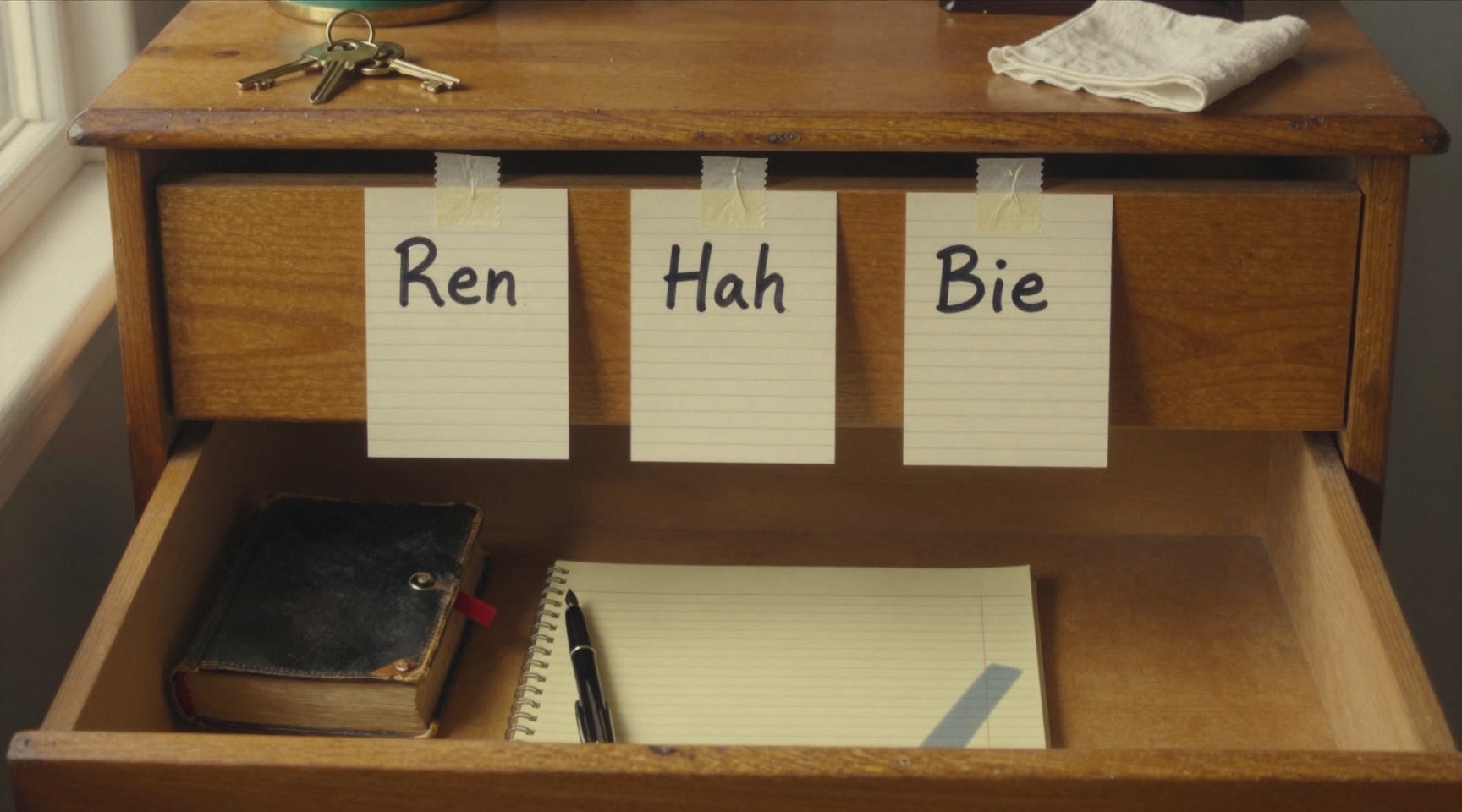
The man sits in his truck in a hardware-store parking lot on a Sunday afternoon, the engine off, a folded yellow legal page in his shirt pocket with three names written on it in his own handwriting. The Send Reflex. Deciding Alone. The Counterfeit Peace. He wrote them yesterday at his kitchen table, the way the article asked. He took the page to his wife last night, the way the article asked. She added a fourth one before he could close his mouth. He drove to the hardware store this afternoon to buy a pack of three-by-five cards and a black felt-tip marker, because the legal page in his shirt pocket is one thunderstorm and one wash cycle away from being illegible, and he has decided, in a way he has not decided about much else this month, that this list is not going to be lost. He sits in the truck and stares at the storefront. The list is the work. The list without a way to carry it is just another piece of paper. He turns the key, drives home, and starts taping the cards to the inside of his desk drawer where he will see them every morning before he opens his laptop. The audit has produced its first artifact. The artifact has to go with him into June.
This is the close of the month. Thirty-one days of named anti-patterns. The Send Reflex. The Sunk-Cost Decision. The Adrenaline Verdict. The 9 PM Decision. The Glory Question Goes Unasked. The Inward Default. The Ventriloquist God. The Echo Chamber Jury. The Magic 8-Ball Bible. The Counterfeit Peace. Knowing Without Doing. Half-Obedience. Acting Out of Order. Twenty-eight named failure modes across the four phases of the Watchman’s Protocol, plus three diagnostic posts at the front of the month and yesterday’s self-mapping exercise. The catalog is built. The reader has the names. The question that closes the month is the only question that matters when a thirty-one day audit ends. How does any of this travel with you when the inbox refills tomorrow.
The anchor for this final article is Habakkuk 2:2. The prophet has been complaining to God about the violence and corruption around him, and God has answered. The answer is heavy. Habakkuk has to do something with it. The Lord says, “Write my answer plainly on tablets, so that a runner can carry the correct message to others” (Habakkuk 2:2, NLT). Read the verse slowly. The answer was not given to be remembered. The answer was given to be written. The writing is for the runner. The runner is the one who carries the message past the moment of revelation into the long obedience of the next year. The message is not preserved by being impressive in the hearing. The message is preserved by being legible on the tablet when the runner has to read it again at sundown in a city he has never been to before. The whole month of May has been a Habakkuk 2:2 exercise. Twenty-eight names have been written plainly on tablets. The runner is the leader reading this sentence. The next twelve months are the road.
The diagnosis underneath this final post is the one anti-pattern the month has not yet named directly, the meta-anti-pattern that swallows every other recovery move if it is not caught. Call it the Closed Notebook. The leader runs the audit. The leader writes the names. The leader resolves to do better. The leader closes the notebook on May 31, slides it into a desk drawer, and never opens it again. By July the names have started to fade. By September the names are gone. By November the leader is running the Send Reflex on a Tuesday afternoon and feeling the small ghost of recognition, the sense that he once read something that named this, the inability to place it. The pattern wins. The Closed Notebook is the failure mode that absorbs every other failure mode, because the audit only counts if the audit is reopened. James names the dynamic with no patience for the soft version. He writes, “But if you look carefully into the perfect law that sets you free, and if you do what it says and don’t forget what you heard, then God will bless you for doing it” (James 1:25, NLT). The phrase that does the work is “don’t forget what you heard.” The Closed Notebook is exactly the forgetting James warns against. The catalog of anti-patterns is not a law that sets the leader free; the Word of God is. The dynamic is the same. The hearing without the keeping is the failure. The naming without the rereading is the Closed Notebook.
The proper pattern for this last day of the month is the same pattern that has run underneath every Watchman’s Protocol article from February forward. The leader who keeps the gate is the leader who has built the rails to keep the gate when his attention is somewhere else. ARREST is the gate. AUDIT is the interrogation at the gate. ALIGN is the calibration to Scripture, Counsel, and the Spirit. ACT is the move that obedience requires. The thirty-one days of May have named the failure modes at each of the four stations. The recovery work is now structural. The leader who finishes this month with three names on a legal pad and no Standing Order on the wall has done half the work. The leader who has the three names and three sentences taped to the inside of a desk drawer has done the full work. Proverbs frames it in a single sentence. “A prudent person foresees danger and takes precautions. The simpleton goes blindly on and suffers the consequences” (Proverbs 27:12, NLT). The precautions are not vague intentions. The precautions are specific rails written down where they can be seen. Hands off the keyboard after 8 PM. Twenty-four hours on any decision involving a member of the team. Two outside conversations before any commitment over a defined dollar amount. The rails are the precautions. The named anti-patterns are the foreseen dangers. The leader who writes both down has the structure the Protocol assumes.
The Watchman’s Field Manual is the next layer of that structure, and tomorrow it goes live as the paid culminating article for the month. The Field Manual is not a re-teaching of the Watchman’s Protocol. The Protocol was the work of February and March, and the chapters of The Decision Fortress sit underneath every article in this series. The Field Manual is the full diagnostic catalog of all twenty-eight anti-patterns in one place, with the diagnostic questions for each one, the recovery moves for each one, the proper pattern restated for each one, and a Personal Anti-Pattern Map worksheet that the leader returns to quarter by quarter as new failure modes surface and old ones die. The Field Manual is the reference shelf the legal-pad list lives on top of. The list says, “These are my three.” The Field Manual says, “Here is what to do the next time any of these three start to run, and here are the twenty-five others to watch for as the year progresses.” The list without the manual is a sticky note. The manual without the list is theory. Together they are the structure of a Watchman who has decided that this month was not a one-time read.
The framing matters, and it is the framing the brief for this article asked for explicitly. The Field Manual is not a sales pitch. The Field Manual is a recovery resource. The reader who has run any of the twenty-eight anti-patterns this year is not a reader who needs a clever closing argument. He is a reader who has lost sleep over a message he should not have sent, a decision he should not have made alone, a peace he later discovered was avoidance. The Field Manual is the document for that reader. The price is the cost of having the diagnostic on the shelf when the next anti-pattern starts to run at 4:47 on a Thursday afternoon.
Three documents ship with the Field Manual tomorrow, and they matter as much as the article itself. The Anti-Pattern Self-Assessment Worksheet walks the leader through all twenty-eight names with diagnostic questions and recovery moves laid side by side. The Personal Anti-Pattern Map template is the one-page document the leader fills out each quarter, naming the current top three and the Standing Orders that close their gates. The Weekly Watchman Review template is the one-page document the leader runs every Friday afternoon for fifteen minutes, identifying any anti-pattern that surfaced that week. The three documents together are the operating system for sustained anti-pattern work that lasts past the close of this newsletter month.
The honest truth about the close of a month like this is that most readers will read this sentence, feel the small pull of the work that is sitting in front of them, and close the inbox. Three months from now the legal pad will be in a drawer they cannot remember labeling. The Send Reflex will be running on a Tuesday afternoon and the ghost of a name will flicker and disappear. The Closed Notebook will have done its work. The reader who escapes that pattern is the reader who treats the structure of the next month as seriously as he treated the reading of this one. The cards on the inside of the desk drawer. The Standing Orders on the wall. The Field Manual on the shelf. The Friday afternoon review on the calendar as a recurring fifteen-minute block. The names of three accountability voices who have permission to ask, plainly, “Is the gate holding.” None of the rails is exotic. All of the rails are the difference between a leader who has read a series and a leader who has been changed by it.
Tomorrow the paid Field Manual lands. The free articles for May close with this one. The names are written. The runner has the message. The road is the next year of leadership. The watchman who keeps his gate is the watchman who knows which gates have a history of breaking and has built the rails accordingly. Take the diagnostics with you. The list is the start. The manual is the shelf the list sits on. Write the answer plainly on the tablet. Carry the message into June.
Leadership Challenge: Before this week ends, decide where your three named anti-patterns from yesterday are actually going to live. Not on a legal pad in a stack of papers, not as a screenshot on a phone you will not scroll back to, not as a vague intention. Where, physically, are the three names and the three Standing Orders going to be visible every morning before you open your inbox. Index cards on the inside of a desk drawer. A laminated card in the front of a leather folder. A whiteboard in a home office. A note pinned at the top of a daily journal. Choose the location. Put them there today. Then add one more structural rail. Block a recurring fifteen-minute review on your calendar, every Friday afternoon, titled Watchman Review, where you ask, plainly, “Which of my three patterns showed up this week, and which rail held or broke.” The audit only counts when the audit is reopened. Where will your three names live where you will see them tomorrow, and what is the recurring time on your calendar where the audit will actually be reopened.