

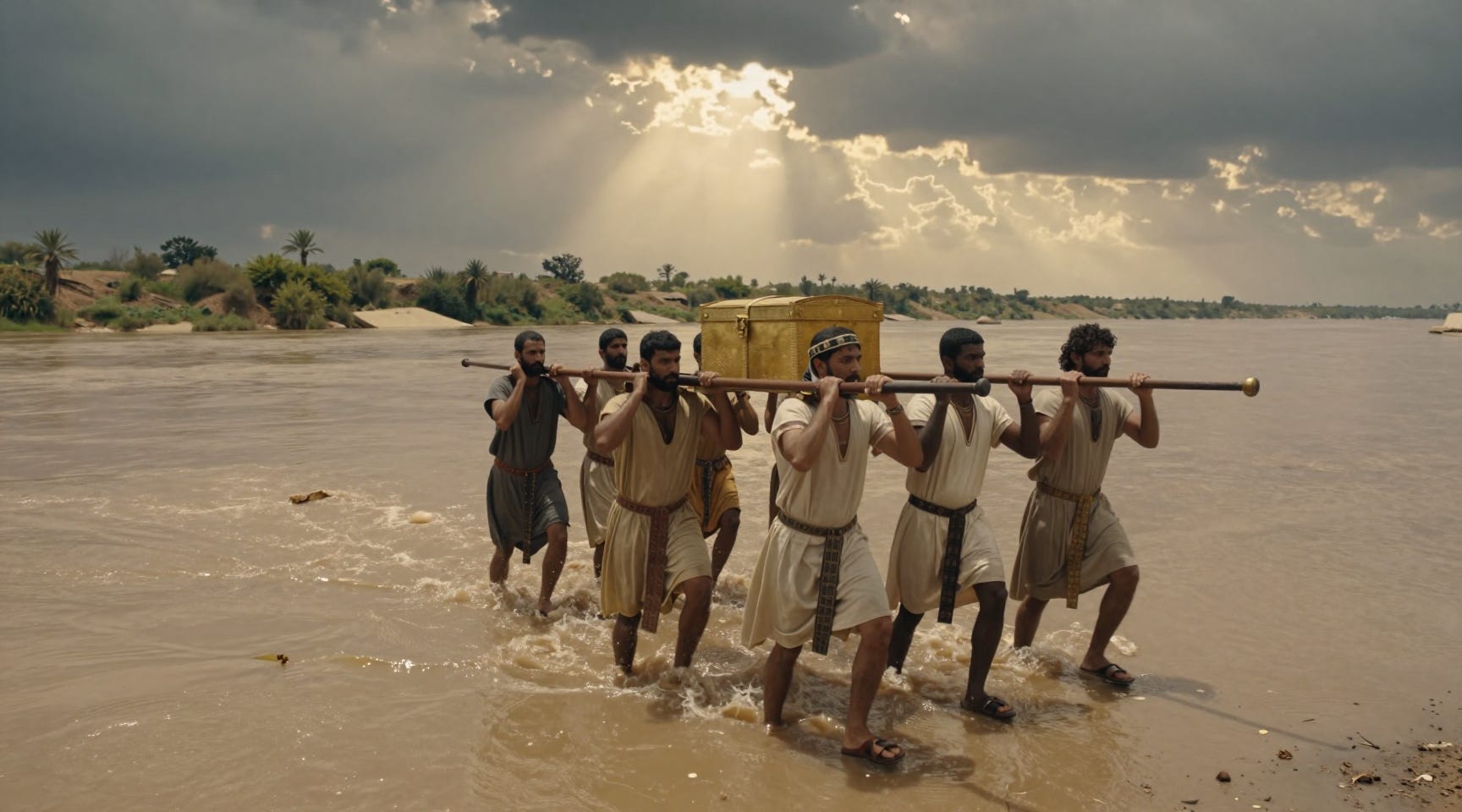
The river is at flood stage and the current is running hard enough that the priests can hear it from the bank. The Jordan in harvest season is not a stream you wade across. It is a wall of brown water moving fast enough to carry a man under before he takes his third step. The twelve men carrying the Ark of the Covenant are standing at the water’s edge, and the command they have been given is to step into the river before the river parts. Not stand at the edge and wait for the water to stop. Not dip a toe and see what happens. Step in. Feet wet. Weight committed. The miracle follows the step, not the other way around. “It was the harvest season, and the Jordan was overflowing its banks. But as soon as the feet of the priests who were carrying the Ark touched the water at the river’s edge, the water above that point began backing up a great distance away at a town called Adam, which is near Zarethan. And the water below that point flowed on to the Dead Sea until the riverbed was dry. Then all the people crossed over near the town of Jericho” (Joshua 3:15-16, NLT). The priests stepped into the flood and the flood stopped. The step came before the deliverance. The obedience came before the evidence. The first thirty seconds of wet feet were the thirty seconds where the Protocol had run its course and all that remained was ACT.
This is the seventh day of our series on The Watchman’s Protocol for Men, and the day we finish the frame before walking the twelve gates next week. ARREST is the halt at the gate. AUDIT is the honest inventory of what is happening inside the man who just arrested the impulse. ALIGN is the subjection of everything we found to the Witnesses of Scripture, Counsel, and Conscience. What remains is the move where the Protocol becomes visible. ACT is the step into the water. ACT is the moment the governed man stops governing internally and starts governing externally. Men fail this move in one of two directions, and the two directions look like opposites but share the same root. The man who freezes. The man who explodes. Both are failing the same move.
The first failure is paralysis. This is the man who has arrested, audited, and aligned perfectly, and then cannot make himself move. He has seen the water. He has examined the current. He has confirmed with his brothers that the Witnesses agree. He is standing at the edge with everything he needs to step in, and he is still standing there. The paralysis masquerades as wisdom. It presents itself as caution, as prudence, as waiting for more clarity. What it actually is, underneath the religious language, is fear. Fear of getting it wrong. Fear of the cost of the decision. Fear of the moment after the step when the consequences become real and cannot be taken back. The paralyzed man has not failed the Protocol. He has failed to complete it. Running three of the four moves is like a watchman who inspected the wall, audited the mortar, aligned the watch rotation, and never opened the gate to let the reinforcements through. “If you fail under pressure, your strength is too small” (Proverbs 24:10, NLT). The test of a man is not how well he prepares for the battle. The test is whether he still fights when the pressure is on. The Protocol is preparation for action; it is not a substitute for action. The man who arrests, audits, and aligns and stays at the water’s edge has mistaken the prelude for the performance.
The second failure is impulsivity. This is the man who runs the Protocol but does not wait for it to finish. He arrests, glances at the audit, skips the align entirely, and acts. The action feels masculine. It feels decisive. The room responds to his clarity with relief. The problem is that the action was premature, and the man who acts before the Protocol has finished is the man who has confused speed with obedience. Solomon wrote the anchor verse for this failure in the plainest language available. “The horse is prepared for the day of battle, but the victory belongs to the Lord” (Proverbs 21:31, NLT). Preparation is required. The horse must be trained. The tack must be fitted. The rider must know the terrain. After all the preparation, the victory is not in the horse or the rider. It belongs to the Lord. The man who acts before the Protocol finishes has confused the horse for the victory. He has trusted his own readiness, his own speed, and he has not waited for the Witnesses to confirm that the direction he is charging is the direction God is moving. The impulsivity looks like boldness. It is impatience dressed in decisiveness, and the cost is paid by the people who trusted the man to do the work before he moved.
What both failures share is the same flawed understanding of ACT. The paralyzed man believes ACT requires certainty, so he waits for the water to part before stepping in. The impulsive man believes ACT requires speed, so he charges before the Witnesses have spoken. Both are wrong for the same reason. ACT requires neither certainty nor speed. It requires obedience. Obedience is the governed step taken after the Protocol has run, not before it has finished and not after it has been abandoned. The step into the Jordan was not certain. The priests did not know the water would part. They knew the command. They had the presence of God carried on their shoulders, literally. They had everything they needed to obey, and they did not have the evidence that the obedience would succeed. They stepped in anyway. The step was the obedience. The miracle was the confirmation.
Joshua received the command that set the entire sequence in motion. “This is my command—be strong and courageous! Do not be afraid or discouraged. For the Lord your God is with you wherever you go” (Joshua 1:9, NLT). The command is not to be strong and courageous after God shows up. The command is to be strong and courageous while the river is still at flood stage, while the evidence that the step will succeed is still invisible. Courage is not the absence of fear. Courage is the presence of fear governed by the Protocol. The priests were afraid at the water’s edge. Any man who says otherwise has never stood at the edge of a flood-stage river with the weight of the Ark on his shoulders and a nation waiting behind him. The fear was present. The step was taken anyway.
What does ACT look like on a Tuesday afternoon? You received an email that made your jaw tighten. You arrested the impulse to respond immediately. You audited: hungry, angry, lonely, tired. The answer was angry and tired. You aligned: Scripture says in your anger do not sin, your counsel confirmed the email was as inflammatory as it felt, your conscience was clear that you had not caused the conflict. Now ACT. The governed response is not to delete the draft. It is to write the response that addresses the issue without adding fuel, to send it the following morning after you have slept, and to cc the person who needs to be in the loop. That is ACT. It is not heroic. It is the small governed step that changes the trajectory of a conflict before the conflict becomes a crisis.
The physics of obedience work against a man’s instincts. Static friction: the force required to move an object from a standstill is higher than the force required to keep it moving once it is already in motion. The first push is the hardest push. The first thirty seconds of obedience cost more willpower than the next thirty minutes. The man who knows this physics can govern himself through it. He does not tell himself that tomorrow will feel easier, because tomorrow brings the same static friction. He knows the first push is the hardest, and he pushes anyway. James drew the line between the man who hears and the man who does. “But don’t just listen to God’s word. You must do what it says. Otherwise, you are only fooling yourselves. For if you listen to the word and don’t obey, it is like glancing at your face in a mirror. You see yourself, walk away, and forget what you look like. But if you look carefully into the perfect law that sets you free, and if you do what it says and don’t forget what you heard, then God will bless you for doing it” (James 1:22-25, NLT). The blessing is not on the man who knows. The blessing is on the man who does. The difference between knowing and doing is thirty seconds of governed obedience, and the man who crosses those thirty seconds crosses the river.
The Protocol has four moves. ARREST. AUDIT. ALIGN. ACT. All four are required. The man who runs three of them has done the prep work and failed to launch. Next week we begin walking the twelve gates: Marriage, Fatherhood, Work, Anger, Integrity, Brotherhood. Every one of those gates will test your ability to ACT after you have run the first three moves. The priests stepped into the flood. The river is still at flood stage. The command has not changed. The miracle follows the obedience.
Leadership Challenge: Identify the specific situation where you are currently failing the ACT. Either you are paralyzed, standing at the edge and waiting for more clarity while calling your fear wisdom, or you are impulsive, acting before the Protocol finishes while calling your impatience decisiveness. Name which failure is yours. Now name the specific ACT the Protocol is asking of you. Not a general direction. A specific, governed step. An email you need to send. A conversation you need to open. A decision you need to make and communicate. The first thirty seconds of obedience will cost you something. Name the cost. Now name what happens if you do not act this week. The river is not getting lower. The current is not slowing down. The command has been given. When are you stepping in, and what is the first move.