

Nobody had to tell you your last boss was impatient. You felt it in the first meeting. The foot tapping under the table. The way she cut people off at the second sentence. The sigh she did not know she was making when someone asked a clarifying question. She never announced her impatience. She never wrote it in a memo. It leaked out of her in a hundred small moments, and the team catalogued every one of them. Character does that. It produces evidence. It leaks through the seams of your leadership before you ever get the chance to frame it with a speech or a values statement. Yesterday we sat with Proverbs 15:1 and the way a leader’s tone sets the temperature of every room. Today we move deeper, from the individual decision of tone to the root system underneath all of it, because tone is just one fruit on a tree, and Scripture names the whole tree.
Galatians 5:22-23 (NLT): “But the Holy Spirit produces this kind of fruit in our lives: love, joy, peace, patience, kindness, goodness, faithfulness, gentleness, and self-control. There is no law against these things!”
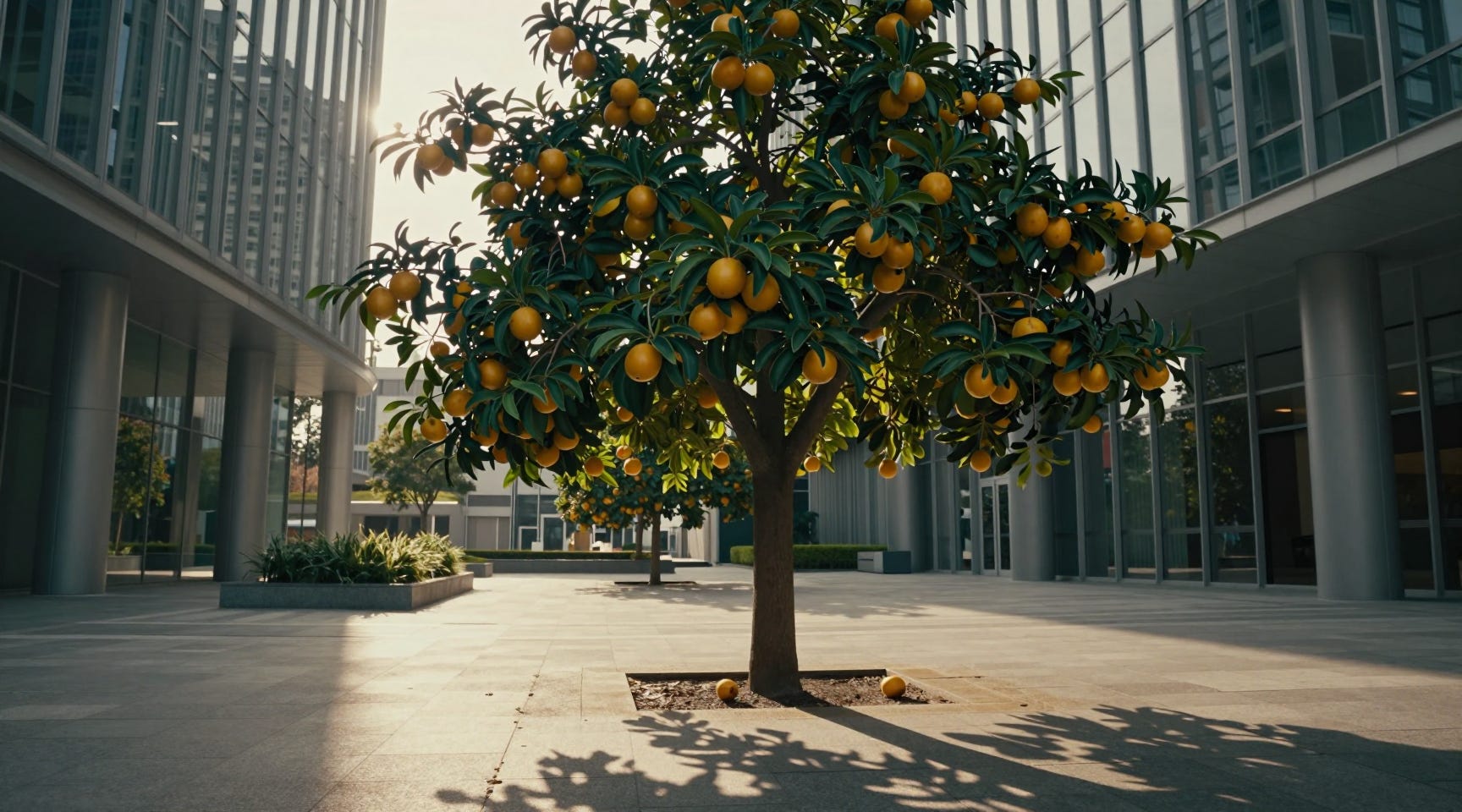
Paul is writing to the churches in Galatia, and the letter is not a calm one. These churches are in crisis. False teachers have arrived and are telling new believers they need to follow the Jewish law in addition to faith in Christ in order to be saved. Paul spends the first four chapters dismantling that argument. Then he pivots to a question that matters for every leader who reads it: if you are free from the law, how do you know you are living rightly? His answer is not a new set of rules. His answer is fruit. You will know the tree by what it produces. The list that follows is not a checklist of virtues to develop through discipline. It is a description of what the Holy Spirit grows in a life that is yielded to Him. The grammar matters here. Paul does not say “produce this fruit.” He says the Spirit produces it. The leader’s job is not to manufacture these qualities through effort. The leader’s job is to stay connected to the vine and stop blocking what the Spirit is already trying to grow.
The context deepens when you read what comes just before this passage. In Galatians 5:19-21, Paul lists the acts of the flesh: hostility, quarreling, jealousy, outbursts of anger, selfish ambition, divisions, envy. Read that list again as a leadership consultant’s diagnostic report. Hostility in the hallway. Quarreling in the leadership team meeting. Jealousy when a peer gets the promotion. Outbursts of anger when a project fails. Selfish ambition dressed up as strategic vision. Divisions carved along loyalty lines. Envy disguised as competitive drive. Paul is describing what grows in a life operated by the flesh, and every leader has seen that harvest in at least one organization. The fruit of the Spirit is the counter-harvest. It is what grows when a different root system is feeding the tree.
Galatians 5:22-23 (NLT): “But the Holy Spirit produces this kind of fruit in our lives: love, joy, peace, patience, kindness, goodness, faithfulness, gentleness, and self-control. There is no law against these things!”
Nobody had to tell you your last boss was impatient. You felt it. The foot tapping under the table. The sigh she did not know she was making. She never announced it. She never wrote it in a memo. It leaked out of her, and the team catalogued every moment. Character does that. It produces evidence before you ever get the chance to frame it.
Paul gives us nine words that describe what the Holy Spirit grows in a yielded life. Love. Joy. Peace. Patience. Kindness. Goodness. Faithfulness. Gentleness. Self-control. This is not a checklist to achieve. It is a harvest report. You do not manufacture fruit. You stay connected to the vine, and the fruit shows up.
Walk through that list slowly. Patience is the capacity to stay long-tempered when the deadline is burning and the team is scattered. Peace is not the absence of conflict; it is the non-anxious presence that holds a room together when everything is going wrong. Kindness is how you treat the person with the least power to push back on you. Faithfulness is whether your word is reliable enough that no one has to wonder if you meant it. Gentleness is strength under control, not weakness wearing a soft voice. These are not personality profiles. They are indicators of what is growing in the root system your team cannot see but can absolutely feel.
Here is the confrontation for every leader. Your team already knows what your tree is producing. They do not need your values statement. They do not need the poster in the break room. They watch you in the meeting when the project falls apart. They watch you when you get the email that makes your jaw tighten. They watch you at 4:45 on a Friday when you are tired and the filter is thin. The fruit is visible. Always. The only question is which list it comes from: the one in verse 19, or the one in verse 22.
You cannot fake fruit. You can fake a speech. You can fake a culture initiative. You cannot fake patience when the deadline collapses and every nerve in your body wants to snap. The fruit is either growing, or it is not. Your team knows before you do.
The leadership demand in this verse is uncomfortable because it removes the leader’s favorite alibi. Most leaders treat character as a private matter. “Who I am on my own time is my business.” “My personal growth journey is between me and God.” Paul demolishes that wall. Fruit is visible. Fruit is public. Fruit exists specifically to be seen, touched, and tasted by the people around you. A tree does not grow apples for its own consumption. It grows them for others. The fruit of the Spirit is not for you. It is for the people you lead. Your patience is not a personal virtue you develop for your own sanctification scorecard. Your patience is the thing your direct report experiences when she tells you the client is leaving. Your kindness is not a personality trait. Your kindness is the thing the junior team member encounters when he makes a mistake in front of the whole department. Your self-control is not a spiritual discipline you practice in the prayer closet. Your self-control is the thing the room sees when you receive news that would justify an outburst, and you choose not to deliver one. The fruit is relational. It is always experienced by someone other than the tree.
This is where the verse confronts the way most leaders actually operate. We have a sophisticated system for displaying the fruit we do not actually have. We put “integrity” on the conference room wall and then shade the numbers in the board report. We talk about “servant leadership” in the all-hands meeting and then micromanage the team through the rest of the week. We claim “patience” as a value while sending the passive-aggressive Slack message at 10:30 at night. Paul’s metaphor is devastating because it eliminates this entire performance. You cannot hang plastic fruit on a tree and call it a harvest. The people standing under the tree know the difference. They have been tasting the fruit for months, and they know whether it is real or manufactured. The leader who talks about kindness while his team walks on eggshells around him has not fooled anyone. The leader whose patience is an act that cracks under the slightest pressure has not fooled anyone either. The team knows. They always know.
Whether Paul ordered the list deliberately or not, self-control sitting at the end is worth noticing. It functions as a container for everything that precedes it. Every other fruit on the list requires it. Love without self-control becomes possessive. Joy without self-control becomes mania. Peace without self-control becomes passivity. Patience without self-control becomes resentment hidden behind a tight smile. Kindness without self-control becomes people-pleasing. Self-control is the container that gives the other fruit its shape. For the leader, this is the whole game. Self-governance is what makes every other virtue safe for the people around you. A leader with deep love and no self-control is a wrecking ball with good intentions. A leader with genuine kindness and no self-control will give away things that are not his to give. The Spirit produces all nine as a package, and the package does not work with missing pieces.
The practice this week is an audit, not an action. Sit with the list of nine. Do not grade yourself on all of them. Pick the one your team would say is most absent. Not the one you wish you were better at. The one your people would name if they were honest. Patience, probably. Maybe kindness. Maybe self-control. Whichever one it is, do not resolve to try harder at it. That misses Paul’s entire point. The fruit is produced by the Spirit, not by your effort. Instead, ask a different question: where am I blocking what the Spirit is trying to grow? What habit, what pattern, what refusal to yield is keeping this fruit from showing up in my leadership? The answer to that question is where the real work begins.
This month we are studying what Scripture says directly to the person in charge. We have moved through the leader’s call in week one and now sit in week two on the leader’s character. Integrity was the compass. Tone was the thermostat. The fruit of the Spirit is the harvest report, the visible evidence of what is growing underneath all of it. Tomorrow we sit with James 1:19, “quick to listen, slow to speak,” and the first leadership skill that almost no one teaches: silence. Carry Galatians 5:22-23 with you today. Watch what your tree is producing. The team already has.
I write about leadership at the intersection of timeless principles and modern workplaces. Follow for weekly insights on building teams that actually work. For more articles like this consider subscribing or sharing.