

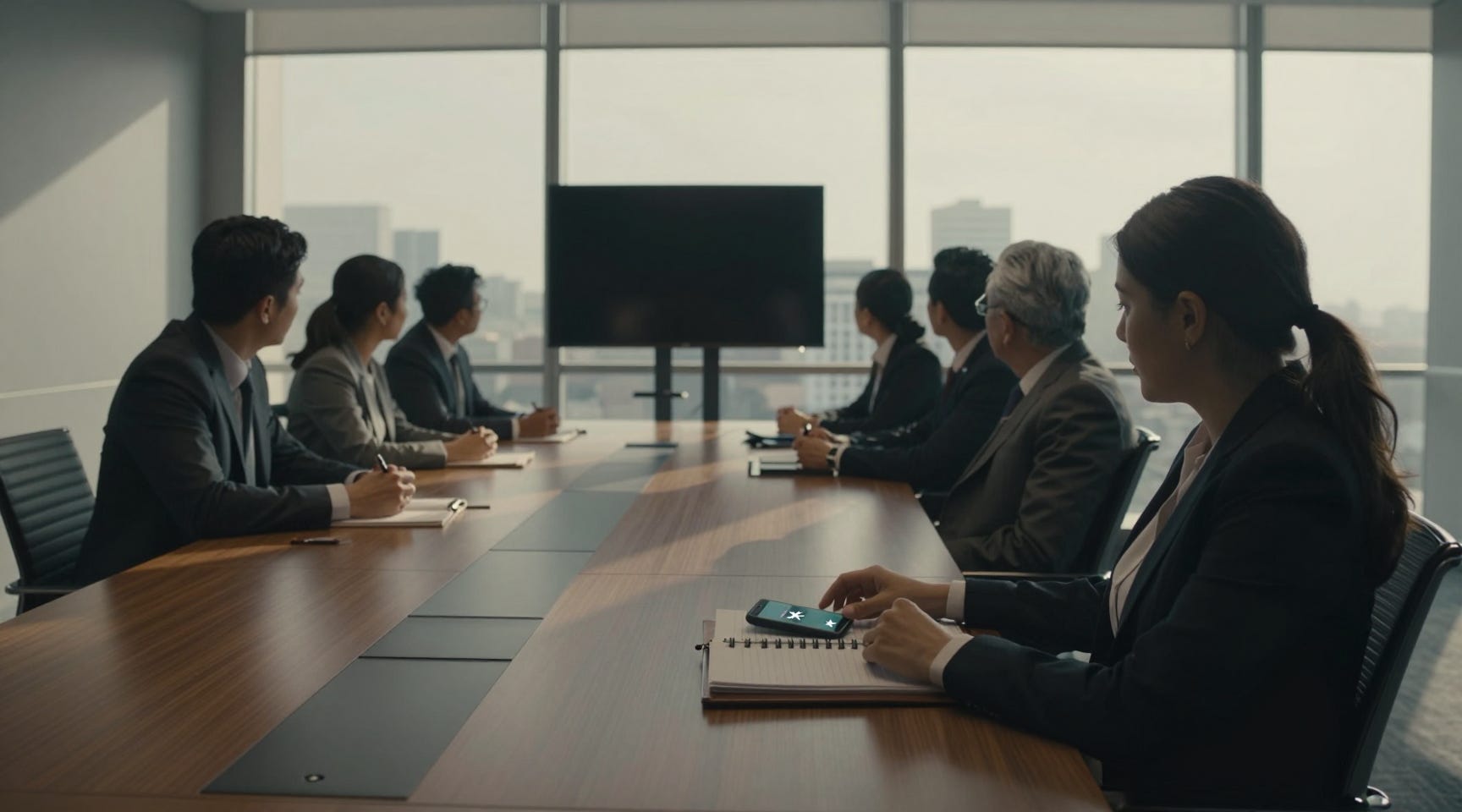
The Q3 strategy off-site is in its third hour. Eight people are around the table, glass walls on two sides, the city skyline doing the slow midday thing where the sun has flattened the shadows. The CEO has soft-launched a direction. He did not call it a decision. He called it “where I think we are landing.” The chief of staff nodded. The CFO said, “I see the logic.” The head of revenue said, “It tracks with what we are seeing.” The product lead said, “I think we can build to that.” Each voice added a quarter ounce of mass to the floor of the room. By the time it is the COO’s turn, the room is no longer a deliberation. It is a destination. The COO walked in with three real concerns. She had typed them on her phone in the hallway before the meeting and starred two of them. She opens her mouth and hears her own voice say, “I am tracking with the rest of the team. I think we are aligned.” Her concerns are still in the phone. The phone is in her lap. The phone does not get pulled out. The room has moved. She moved with it. She tells herself this is executive maturity.
We have spent five days alone with the leader. The Send Reflex was the body acting before the mind. The Urgency Counterfeit was pressure wearing the Spirit’s vocabulary. The Sunk-Cost Decision was yesterday’s bill making today’s call. The Adrenaline Verdict was the chemistry in the body running the office. The 9 PM Decision was the clock and the cortisol curve issuing the verdict in the leader’s place. All five of those gates failed inside one body. Today’s gate fails differently. Today’s gate fails because there are seven other bodies in the room, and they are all moving in the same direction.
The pattern is the Group Slipstream.
The Group Slipstream is the verdict a leader produces when the only thing standing between her real conviction and the room’s momentum is the social cost of being the one who slows the train. The leader does not consciously cave. She does not feel pressured. She feels the warmth of agreement, the energy of the room synchronizing, the small dopamine hit of being part of a team that is finally aligned, and she mistakes that warmth for confirmation. The phone in her lap stays in her lap. The starred concerns stay starred. The decision happens to her, not through her. The slipstream is the air the lead car displaces; the cars behind do not have to do as much work, because the lead car is doing it for them. Most leaders do not think of themselves as drafting in a slipstream. Most leaders are drafting in a slipstream three to four times a week.
The flesh wears several costumes for this anti-pattern, and they are all professionally respectable. The first costume is collegiality: “I do not want to be the one who blocks the room.” The second is executive maturity: “I have learned to pick my battles.” The third is reading the room: “If everyone else is on board, my read must be off.” The fourth, and the one most lethal to the Watchman, is humility dressed up as deference: “Who am I to hold up the meeting? Maybe I am missing something the room sees.” Each of those costumes has an honest version, and each has a costume version. The honest version is real humility, real maturity, real collegiality. The costume version is the same word with the gate quietly open behind it. The diagnosis is not whether the leader said the collegial thing. The diagnosis is whether the gate was actually consulted before she said it.
Scripture is direct on this. Moses writes in the law, “You must not follow the crowd in doing wrong. When you are called to testify in a dispute, do not be swayed by the crowd to twist justice” (Exodus 23:2, NLT). The verse is not asking the leader to be contrarian. The verse is naming a specific failure mode: the crowd has gravity, and the gravity will pull the testimony if the testimony is not anchored before the gravity arrives. Long before any group polarization study had been published, Moses had named the dynamic that any conference room produces in the third hour. The crowd will twist the verdict. The Watchman has to hold the verdict to the gate, not to the room.
The cost of failing this gate is on display in Numbers 13. Twelve scouts went into the land. Ten came back with the same report, the same tone, the same conclusion: the giants are too big, we cannot take this. Caleb tried to quiet the room before the slipstream owned it. He said, “Let’s go at once to take the land. We can certainly conquer it!” (Numbers 13:30, NLT). The room did not stop. By the next chapter, Joshua had joined Caleb on the floor, and the two of them stood together against ten voices and a camp the size of a nation. Numbers 14 records that the community wanted to stone them. The slipstream of the ten produced a generation refusing to enter and forty years in the wilderness. The room was ten to two. The room was wrong. Caleb and Joshua held the gate. Forty years later, they were the only two adults from that generation who walked into the land. The room had its gravity. The gate had its weight. The weight outlasted the gravity.
In Protocol terms, the Group Slipstream is what happens when ARREST never gets a chance to fire because the leader does not realize the gate is even being approached. ARREST is most often described as halting the spiraling thought; in a moving room, the spiraling thought is the room itself. The gate is invisible to a leader who is reading social cues instead of internal signal. The Watchman in a moving room is a slower beat than the room is keeping. The Watchman is the one who notices that the conviction she carried in is not the conviction she is about to vote with, and the gap between those two convictions is the gate. The room does not see her gate. Only she does. The room is not going to ask her to slow down. The slipstream is too efficient for that.
The recovery for this anti-pattern starts before the meeting. The first move is the pre-meeting note. Five minutes before any high-stakes meeting, the leader writes down, in her own words, the conviction she is bringing in and the concerns she will not surrender without a hearing. The note lives somewhere visible during the meeting: on a notepad open in front of her, in a starred message she sent herself, on a sticky note tucked into the planner. The note is the gate’s anchor. It is harder for the slipstream to override a written conviction than a remembered one. The second move is the naming pause. When the leader feels the room moving, the move is a single sentence: “Before we land here, I want to name a concern.” That sentence is a Standing Order in nine words. It does not require eloquence. It does not require certainty. It requires only that the leader speak before the floor closes. The third move is the time request. If the room is too far ahead and the leader needs to think, the request is, “Can we hold this decision for twenty-four hours?” Most rooms can hold most decisions for twenty-four hours. The decisions that cannot are rare and easy to identify. The fourth move is the minority report. If the room insists on moving forward and the leader cannot stop it, she states for the record, “I want my dissent recorded even if we proceed.” That sentence is the difference between deference and abdication. Deference says, “I will defer to the room and own the outcome with you.” Abdication says, “The room said yes, so my read does not exist.” The Watchman defers without abdicating.
A leader who has been running the Group Slipstream will recognize the move set by what changes in the next meeting. The phone with the starred concerns comes out. The naming sentence gets used at least once. The room slows for ten seconds. The CEO does not love the slowing, but he respects the leader who slowed it. The decision the room lands on either gets stronger because the gate held, or gets quietly redirected because the concerns were real. The relationships in the room do not weaken; they actually deepen, because the team has just learned that the leader will speak even when the room is comfortable. That is the executive presence the costume of executive maturity was always pretending to be.
Tomorrow we look at speed itself. The “Just Real Quick” Lie is the anti-pattern that hides the entire Protocol behind a pace fast enough to skip the gate without anyone, including the leader, noticing. The 9 PM Decision used the clock. The Group Slipstream uses the room. Tomorrow’s pattern uses the calendar, the inbox, and the texture of modern leadership where the next thing is always more urgent than the last thing. The gate that fails to a moving crowd is one species of gate failure. The gate that never gets reached because the leader is moving too fast to find it is its own.
The room will move. That is what rooms do. The Watchman is not the leader who refuses to be in rooms. The Watchman is the leader who carries a written conviction into the room, names it when the floor starts to close, asks for time when the gate needs more than the meeting can give, and records dissent when the room moves anyway. Pre-decided governance is what allows an outnumbered Watchman to hold. The complete Field Manual at month’s end will gather all twenty-eight anti-patterns into a single recovery resource. Until then, one gate at a time, and today, the gate is the one the room is most quietly trying to walk you past.
Leadership Challenge: Pull the last three meeting decisions you signed off on. For each one, can you answer in one clean sentence what your real conviction was when you walked in, and what your vote actually said when you walked out? If those two answers are not the same, the Group Slipstream owns at least one of those gates. Before your next high-stakes meeting, write your real conviction on a notecard, place it on the table in front of you, and use it.