

The email landed at 9:14. Reassigned pending review. By noon the badge failed at the side door. She sat in the parking lot and assumed the work would stall without her in the room. By Thursday a manager two buildings over was running the standard she had spent two years putting in people, using her language, without asking her permission. The access was gone. The teaching was not.
Paul would have recognized the math. He is in chains in Rome. This is the last letter. Yesterday he gave Timothy three pictures of endurance: the soldier who will not get tangled, the athlete who will not cheat the rules, the farmer who stays long enough to taste the crop. Endurance still needs a reason. Today he names it. The messenger can be confined. The message cannot.
This month we are walking through Paul’s final letters to Timothy, the closest thing the Bible has to a leadership mentorship manual passed from a veteran to his protégé. Phase 4 is suffering and endurance. The tone is intensity. A man who is almost out of time will not let Timothy confuse a chain on the wrist with a chain on the word.
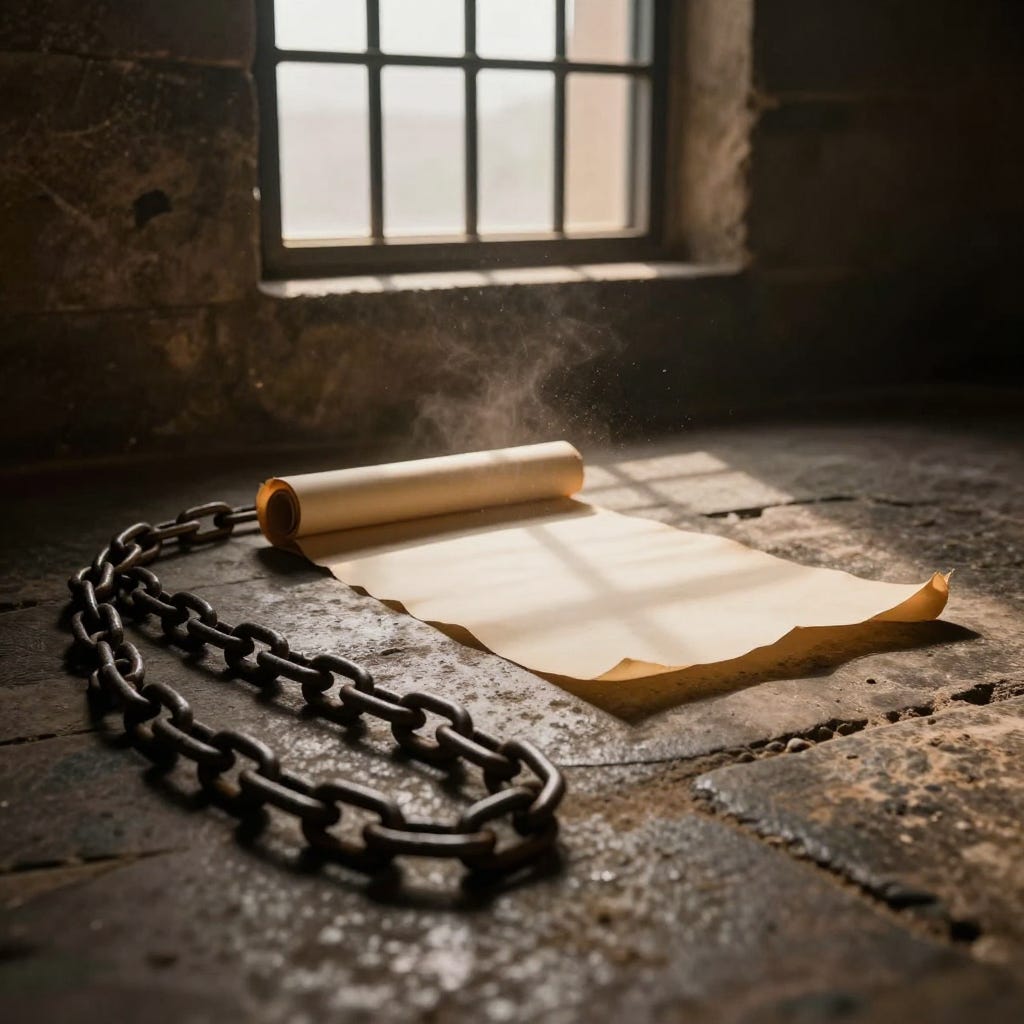
“Always remember that Jesus Christ, a descendant of King David, was raised from the dead. This is the Good News I preach. And because I preach this Good News, I am suffering and have been chained like a criminal. But the word of God cannot be chained. So I am willing to endure anything if it will bring salvation and eternal glory in Christ Jesus to those God has chosen.” (2 Timothy 2:8-10, NLT)
Let that sit. Always remember. Not a new strategy. A Person: Jesus Christ, descendant of David, raised from the dead. That is the Good News Paul preaches. The cost of preaching it is not subtle. He is suffering. He has been chained like a criminal. Then the sentence that rearranges the cell: the word of God cannot be chained. Then the motive: he will endure anything if it brings salvation and eternal glory to the people God has chosen. Paul does not ask Timothy to pretend the chain is imaginary. He asks him to stop treating the chain as the limit of the work.
Rome did not give him the dignity of a political prisoner. Criminal is the classification. The apostle who planted churches across the empire is now the kind of man you put in irons so the city will not take him seriously. Paul refuses the city’s verdict as the last word on the assignment. The man can be held. The risen Christ cannot be held. The word that announces Him cannot be held either.
The principle is simple enough to write on a whiteboard and hard enough to keep when your platform shrinks. A leader’s circumstances can be restricted while their influence expands. The chain on your wrist does not determine the reach of what you were given to carry. Paul is talking first about the Gospel in a hard city, preached by a man Rome has classified as a criminal. The pictures still tell the truth about any leader who thinks the work dies when the badge dies. I have made that mistake. I treated access as the same thing as influence. When a room closed, I assumed the standard closed with it. Some of the best transfer I have ever seen happened after I was no longer in the meeting. Whether you are a believer or still exploring, you already know this pattern. A founder locked out of the company still hears their language in the product. A director on leave watches the team run the review she taught. A manager who lost the budget still sees the practice travel to a region that never needed her slide deck.
Paul had already lived this in an earlier imprisonment. “And I want you to know, my dear brothers and sisters, that everything that has happened to me here has helped to spread the Good News. For everyone here, including the whole palace guard, knows that I am in chains because of Christ. And because of my imprisonment, most of the believers here have gained confidence and boldly speak God’s message without fear.” (Philippians 1:12-14, NLT)
Helped to spread. The palace guard knows. Other believers got bolder because he was in chains, not in spite of it. The confinement became a hallway. Rome meant to isolate a preacher. Rome accidentally staffed a congregation with soldiers who had to stand next to him. That is not a productivity hack. It is what happens when the thing you carry does not require your preferred room.
I need to be honest about what this is not. Restricted circumstances do not automatically produce holy influence. Some chains are the fruit of our own foolishness. Some silence is earned. Paul is not baptizing every sidelining as persecution. He is chained because he preached Christ, not because he mismanaged a budget. The test is narrower. What did you actually put in people before the door closed? If the work required your badge, the chain will stop it. If the work was a true thing already entrusted to trustworthy people, the chain will only stop you.
That is why yesterday’s three pictures still matter. A soldier who stayed free of extra tangles had something left to hand on when the cell door shut. An athlete who kept the rules had a word that could travel without shame. A farmer who stayed in the field long enough had fruit other people could eat without him in the row. Endurance is not a mood you perform until the badge comes back. Endurance is how the unchained word keeps moving while you wait.
Bring it to Tuesday afternoon. First, name the chain in one sentence. Not the story you tell at dinner. The actual restriction. The frozen headcount. The legal hold on what you can say. The health limit on travel. The reorg that moved you off the stage. The reputation hit you cannot litigate this quarter. Write it down. A chain you will not name will keep pretending it is the whole assignment.
Second, name the word that is not chained. Paul pointed Timothy back to Jesus Christ, raised from the dead. Start there if that is the deposit you carry. Then get concrete about the true thing you were given to hand on at work: the standard, the way you tell the truth, the practice you taught when you still had the room. If you cannot name it without naming yourself, it was never a word. It was a personal brand.
Third, make one move this week that sends the work without requiring your circumstances to improve first. Teach the standard to someone who can carry it into a room you cannot enter. Write the one-page version and give it away. Introduce two people who do not need you in the middle. Decline the temptation to wait for the badge to come back before you steward what is still free.
I will not pretend this is tidy. Some chains last longer than the quarter. Some rooms stay closed. Some people will use what you taught and never mention your name. Paul knew that. He is writing from a cell, classified with criminals, asking a younger leader to remember a risen Christ instead of a confined mentor. The other path has a cost too, and it compounds. You wait for better conditions before you release the work. The team learns that the standard is a platform, not a truth. When the next chain arrives, nothing travels.
The Field Manual at the end of this month will put this under the Leader’s Suffering: the chain and the word. Circumstances do not get the last word on influence. February’s Protocol and March’s Fortress are downstream of this sentence. You arrest the impulse to confuse access with fruit. You build an inner life that can keep handing on the truth when the room shrinks. The source is older than those frameworks. A mentor in chains told a younger leader that Rome could hold a man and still fail to hold the message.
Tomorrow Paul will press the worker who handles that unchained word. “Work hard so you can present yourself to God and receive his approval. Be a good worker, one who does not need to be ashamed and who correctly explains the word of truth.” (2 Timothy 2:15, NLT) The young leader in Ephesus did not need a more inspiring prison story. He needed to stop treating a restricted season as a cancelled assignment.
Leadership Challenge: What chain is actually on your wrist this week? What true thing can still travel without your badge, and what one move will you make that does not wait for better conditions?
I write about leadership at the intersection of timeless principles and modern workplaces. Follow for weekly insights on building teams that actually work. For more articles like this consider subscribing or sharing.